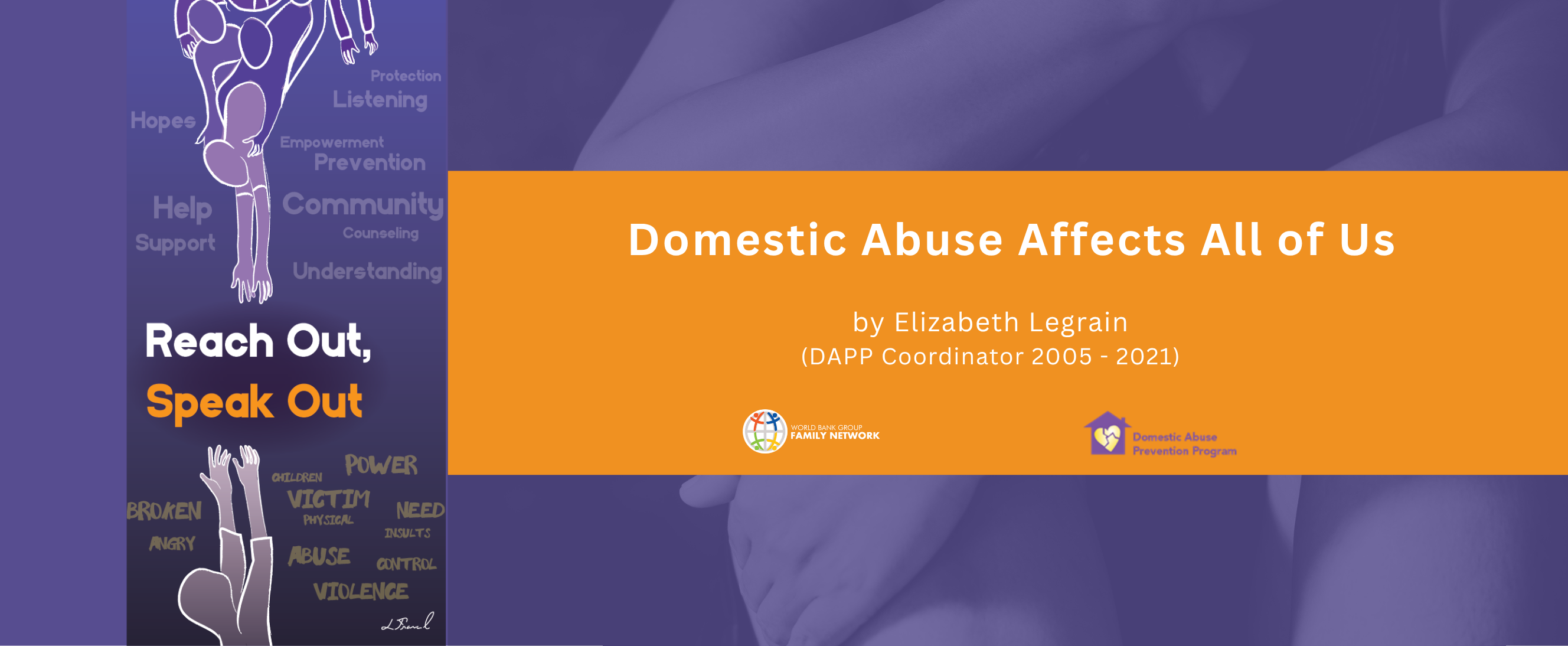
Domestic Abuse Affects All of Us
Domestic violence (domestic abuse, intimate partner violence) is a scourge of global proportions and a significant public health issue affecting an estimated 30% of women globally. The costs are staggering and cut across ethnic origins, religion, education, age, gender, geographical location, sexual orientation and socio-economic groups. It is encountered in all workplaces, and the World Bank Group is no exception.
Despite it being so common, there are still myths about what it is and who it happens to. Domestic abuse (DA) comes in a range of forms in addition to physical violence - economic, sexual, psychological, and aims to gain or maintain control over another person. Victim-survivors often talk about “walking on eggshells” around their abuser, as well as being “gaslit,” frightened, isolated, in fear of their safety and of their lives. It is mobile, pervasive, and follows survivors and perpetrators wherever they go, including the workplace.
The first reported case at the World Bank Group was brought to Senior Leadership’s attention in 1974 by the World Bank Group Family Network (previously WIVES, WBVS), but management declined to intervene as it was considered as a personal matter. At the time, G4 visa dependents were not allowed employment, and the WBG’s privileges and immunities exempted accepting court orders for spouse and child support. Staff Rules provided little recourse to protect victims.
WBGFN continued to advocate for changes and progress was made. In 1988, COPE was contracted as Family Consultation Service (FCS) to provide counseling to spouses undergoing stress. In 1994, an amendment to the Staff Retirement Plan allowed the Bank to respond to court orders without waiving its privileges. In 2001, the then-WBG President provided WBGFN $50,000 from the President’s discretionary fund to document and report on the incidence of domestic abuse. Within six months, 25 cases came forward, 15 spouses and 10 staff; all women shared their experiences and asked for help. It became clear that it was happening to colleagues and family members, silently, and far more often than realized.
Several of the recommendations in WBGFN’s report were immediately implemented:
- Establish a specialized unit as a “single entry point” to coordinate assistance
- Create an Advisory Board with staff from various Bank units,
- Develop educational brochures to mount in women and men’s restrooms (WBGFN has since translated brochures in six languages),
- Provide limited emergency and legal funds,
- Allow spouses confidential access to a staff’s salary, benefits, and pension information
- Implement a preventative strategy and provide help for an alleged abuser.
The WBG, then and now, does not impose a zero-tolerance policy mandating termination of a Bank staff when a judgement has been issued to risk penalizing the family and exacerbating the abuse. A criminal conviction may result in disciplinary action.
Twenty-five years of progress
The Domestic Abuse Prevention Program (DAPP previously called HUB) has grown in the past 25 years. In 1995, the International Monetary Fund and the Inter-American Development Bank contracted with the World Bank. In 2012, the program was moved from Human Resources to the Health & Safety Directorate’s Counseling Unit as VP HR Sean McGrath considered DA a health concern with physical and psychological consequences. During this period, the Domestic Abuse Coordinator position became a staff appointment and few years later a Case Manager was hired.
Additionally, Staff Rules were revised to address court orders for spouse and child support, dual divorce decrees, accommodative leave policies for staff, and include domestic abuse in the Code of Ethics. The Procedure for the Domestic Abuse Prevention Program states that, “WBG makes all reasonable efforts to provide a safe work environment and good health for Staff and immediate families”. Security measures were taken to provide loaner cell phones to survivors, block abusers access to the workplace, revise parking or office location of a staff, etc. More recently, codified policies were implemented to clarify the role of DAPP and its DA Advisory Committee.
DAPP since its founding, has focused on providing a strong awareness and a communications campaign as a preventative strategy. Events are focused during October, Domestic Violence Awareness Month in the United States, and 16 Days of Activism against Gender-Based Violence from November 25, through December 10. DAPP developed online training for managers on how to respond to a staff in crisis and risk of workplace violence, and the DA Coordinator provides training sessions throughout the year. WBGFN initiated Spouse Orientations to provide useful information including knowledge of resources such as the Family Consultation Service (FCS) and DAPP. This year, HR's campaign to collect contact information from spouses and partners has helped increase awareness among WBG family members of the information, resources, and services available to them across the World Bank Group, including those provided by Health & Safety Directorate.
Global challenges and future
An updated 2016 DAPP Evaluation Report states the DAPP budget has not kept pace with the growth of the program through the years. The WBGFN Barry McIsaac fund established in early 2000s, has depleting reserves. Another challenge is to create deterrent measures to discourage perpetrators from continuing abuse and consequences. In the past few decades, a marked increase in “trailing” male spouses and staff relocations to Country Offices have added more pressure on families. Many countries where staff and families reside have weak legal protections. Digital and online abuse such as cyberstalking, online harassment, and non-consensual image sharing along with physical abuse add more risks.
Progress is possible. The UN Secretary General’s 2026 report states 87% of countries have enacted domestic violence legislation, and more than 40 countries have strengthened constitutional protections for women and girls in the past decade. Brazil hosting FIFA Women’s World Cup 2027™ is leveraging platform for social mobilization, education and public engagement, and international promotion of equality, respect, and safety. The WBG’s Gender Group within its strategy has a focus on ending gender-based violence, building resilient human capital, expanding economic opportunities, and engaging women as leaders in the WBG’s external activities. The DAPP continues to provide a free, safe, non-judgmental space for anyone who might be experiencing abuse or wants to stop using abuse.
Acknowledgements
Progress could not have been made without the vision of WBG President and Mrs. Wolfensohn, WBGFN Presidents and many volunteers who worked tirelessly to push agenda forward, strong leadership from Senior Management, DAPP managers Geremie Sawadogo, Fons Marcelis, and Stuart Fisher, Advisory Committee members, and WBGFN Coordinators Louise Shimuzu and Catherine Mathieu. Thank you to many volunteers and colleagues who have contributed to the success of the program through the years and the many resilient and brave survivors who have been supported by program. I wish much success to Gamu, the DAPP Coordinator, in moving DAPP to the next phase.
Elizabeth Legrain, DAPP Coordinator 2005-2021
DAPP 24/7 confidential hotline 1-202-458-5800, daprevention@worldbank.org
https://www.worldbank.org/en/work-with-us/hsd/home/domestic_abuse_prevention_program