What if volunteering wasn’t just about what you give, but also about what you learn?
By Sandipa Thapa Basnyat
Volunteering is often described as giving our time and expertise to others. But at the World Bank Family Network (WBFN), volunteering is much more than that. It is an opportunity to learn, gain valuable insights into leadership, communication, collaboration, cultural awareness, and most of all, adaptability.
For more than 53 years, WBFN volunteers have shared their knowledge, talents, and experiences to support peer learning and strengthen the community. In the process, they discovered that volunteering is also one of the most meaningful forms of experiential learning - helping them develop new skills, gain new perspectives, and build meaningful connections.
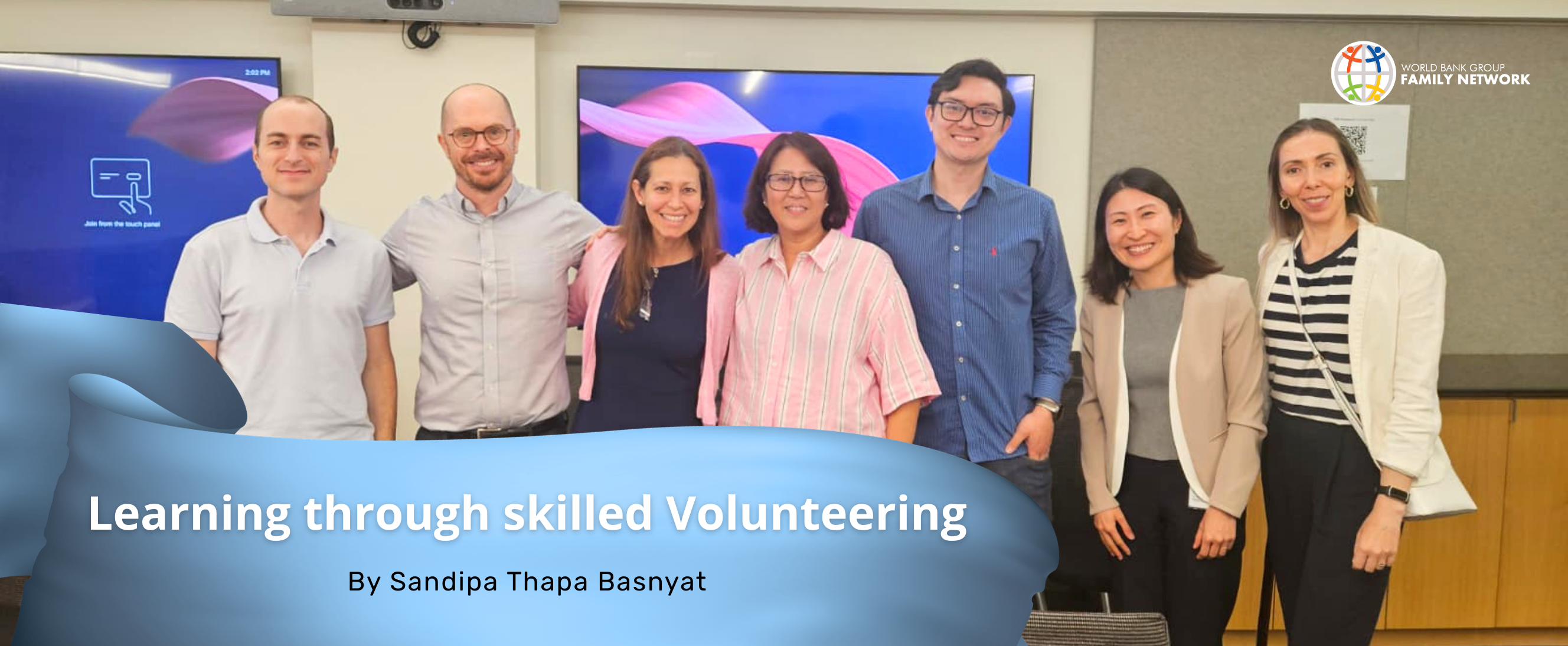
In conjunction with this month’s theme, Learning through Skilled Volunteering, below are stories, including my own, from Professional Development Program (PDP) volunteers that shows how our experiences as skilled volunteers have become a true two-way exchange: we give what we know while learning from the people, perspectives, and experiences around us.
Sandipa: My own volunteer journey with WBFN over the past 18 years, and now as a Career Program Advisor, has been one of the most enriching learning experiences of my career. From helping shape WBFN's strategic framework to working alongside volunteers from diverse backgrounds, I have strengthened my leadership, stakeholder engagement, and cross-cultural skills while learning the importance of trust, shared purpose, and inclusive collaboration. Skilled volunteering creates a unique space where learning happens through action, allowing us to contribute our expertise while continuously growing ourselves. As the experiences shared by our Professional Development Program volunteers illustrate, volunteering is not a one-way act of service but a meaningful opportunity to learn, connect, and make a lasting impact.
Richard Vogt: Along with a team of volunteers, I participated in facilitating a series of 30 drop-in sessions where dozens of WBFN members were allowed to use a resume-tailoring tool called JobScan to strengthen their job application materials, improving participants’ chances of passing Applicant Tracking Systems (ATS), often the first hurdle in the job application process. I contributed primarily through communication and instructional skills, guiding participants in how to navigate the software and refine their materials. My participation allowed me to learn this valuable tool and apply it directly to my own job search. Engaging with participants also gave me insight into a wide range of professional paths, challenges, and strategies, broadening my perspective on the job market. My experience volunteering with the program also emphasised the importance of active listening, and I was struck by the mutual empathy that emerged through our shared experience of job searching. I had the feeling that being able to talk openly like this gave a real sense of encouragement and solidarity. It was a strong reminder of the value of collective learning and knowledge-sharing within the WBFN community.
Walter Guevara: As Professional Development Programs Lead, working with the WBFN PDP Executive Committee Chair, I contributed program strategy, stakeholder engagement, and partnership development, helping lead initiatives that reached more than 800 attendees during the last fiscal year across both established and new topics. What I gained went well beyond program delivery. Leading an entirely volunteer-driven team taught me to lead through influence rather than authority: when people are contributing their time freely and there are no traditional levers of hierarchy or compensation, engagement must be earned continuously. I also strengthened my ability to navigate institutional culture, manage cross-cultural team dynamics, sustain commitment through team transitions, resolve interpersonal challenges, and build partnerships across organizations. These have been some of the most transferable leadership lessons of my career, precisely because they were learned through trust, shared purpose, and voluntary commitment.
Joyce See : As the volunteer lead for WBFN Career Lab, my role has evolved over the years, giving me opportunities to innovate and create meaningful career development initiatives for our members. What I value most is the diversity of knowledge and perspectives, especially in today’s rapidly evolving economic landscape and its impact on hiring decisions. Building on my previous corporate experience as a hiring manager, I have gained new insights into the hiring process from the start, as well as how culturally nuanced the job search can be. These perspectives have fueled my curiosity to keep learning through workshops and certification courses on career navigation, professional resilience, portfolio development, and even the growing popularity of fractional work. Beyond continued professional development, volunteering has given me greater confidence and empathy in supporting others toward their career aspirations. It has been incredibly rewarding and meaningful.
Ana Sebastian Lopez: I am delighted to help my students develop their Spanish language skills, not only because of the diversity of Spanish-speaking cultures but also because this language opens doors in the job market nowadays. This experience allows me to meet wonderful people and discover, alongside them, what it is like to embark on learning Spanish as a foreign language for the first time.
Furthermore, I believe that, by teaching these classes, I myself refine and strengthen certain skills. Among these, I would highlight ‘language awareness’ – that is, the ability to recognize and understand the challenges students face when learning Spanish. In order to help them with their learning, I have realized that my knowledge of other languages – in this case, English and French – enables me to compare the grammatical structures of the student’s mother tongue or of English with those of Spanish, and thus understand the source of their mistakes. Thanks to this, I can adapt my explanations and present concepts more effectively and clearly to my students. I believe that this is helping me to strengthen my adaptability and oral communication skills. Language teaching also fosters other communication skills, such as active listening. I have realized that this skill is essential when carrying out oral expression exercises and reading aloud with students. Furthermore, the language teaching community agrees that learning is more enjoyable and easier when a variety of communication methods and materials are used. For this reason, I believe that since I started teaching Spanish, I have become a more creative person, as I am always looking for different types of exercises, as well as videos, reading materials, and other forms of oral and written expression, so that my students can practice what they have learned and consolidate their knowledge.
Helina Ayele: My volunteering journey with WBFN began when I moved to Washington, D.C., in June 2025. I first participated in the VCL program, where I discovered a community of people with interests and experiences similar to mine, including the shared challenge of relocating and navigating the U.S. job market. This experience inspired me to become a volunteer so that I could share my own knowledge while learning from others. Through PDP, I have applied my strategic-thinking skills to develop a concept note for a new mentorship program. I have also used my relationship-building and facilitation skills to support members as they navigate their job searches and prepare to enter the U.S. workforce. Having personally benefited from professional coaching, I have enjoyed sharing the insights and lessons I gained with others who may benefit from them. Volunteering has strengthened my skills while teaching me valuable lessons about shared responsibility, empathy, collaboration, and community building. It has been a rewarding experience that has contributed meaningfully to both my personal and professional growth.